VTT vs. SRT: Which Subtitle Format Should You Use for Video?
I have a .vtt file but Facebook wants an .srt! What do I do?"
VTT vs. SRT: Which Subtitle Format Should You Use for Video?
The Subtitle Dilemma: Format Wars in 2026
Video is the undisputed king of content. But a great video is useless if your audience can't understand it. In 2026, accessibility isn't optional; it’s a requirement for reach. Captions increase engagement, extend watch time, and are essential for viewers who watch without sound (up to 80% of mobile users!).
But when you go to upload your subtitles, you face a technical roadblock: The battle of the file extensions. Do you use .vtt (WebVTT) or the classic .srt (SubRip Subtitle)? Choosing the wrong one can lead to syncing errors, missing formatting, or, worst of all, an unreadable file that platforms reject.
The Classic King: Understanding SRT (SubRip Subtitle)
SRT is the legacy format that built modern subtitles. If you have been editing video since the early 2000s, you know SRT.
-
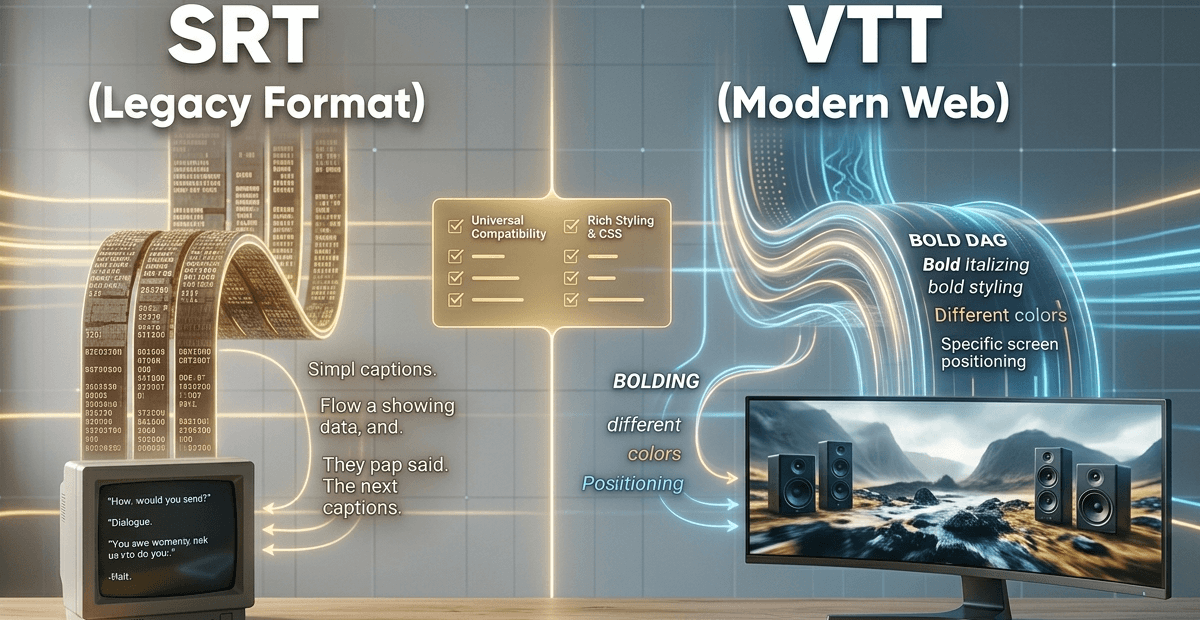
The Pro: It is the most universally compatible subtitle format. It works on virtually every player, from VLC to Facebook and YouTube, and is widely supported by older broadcasting equipment.
-
The Con: It is extremely basic. It only supports the simplest HTML-style formatting (
<i>,<b>,<u>) and does not store positioning, speaker details, or style information.
The Modern Standard: Why VTT (WebVTT) Rules the Web
VTT is the open standard created for HTML5 video players. It is designed for the modern, streaming-focused web.
-
The Pro: VTT is rich with features. It supports advanced styling via CSS (colors, backgrounds), precise positioning on the screen, alignment, and even metadata for defining the main speaker of a dialogue. If your video player is running in a browser (like Netflix or YouTube), VTT is almost always the native format.
-
The Con: While universal on the web, VTT is less compatible with traditional broadcast software or older video players, which can lead to display issues on those platforms.
When to Use VTT and When to Use SRT (The 2026 Checklist)
The format you choose depends entirely on your target platform and required features. Use this checklist to guide your final decision:
-
Use SRT if:
-
You are uploading to a classic player or older broadcasting system.
-
You don't need styling or special positioning.
-
The destination platform (like Facebook, historically) only accepts .srt.
-
Your priority is maximum, legacy compatibility.
-
-
Use VTT if:
-
The destination is an HTML5 video player on the modern web.
-
You need precise screen positioning or complex styling (colors, backgrounds).
-
You are working on professional streaming projects with multiple speakers or technical dialogue.
-
You are optimizing for accessibility and detailed descriptions.
-
Conclusion: Convert Subtitles Instantly with HelpingWebTools.com
In 2026, you shouldn't have to manually re-type or convert your subtitle files. If you have the wrong file extension for your project, don't let it delay your upload. Use the free HelpingWebTools.com converter to bridge the gap:
Stop fighting format wars and get back to creating great content. We make subtitle compatibility easy.
💡 Pro-Tip for 2026:
Did you know that you can actually open a VTT or SRT file in a plain text editor? They are just raw text files with a structured timecode. Before you convert, you can use our Text Case Converter (part of the 35 original tools) to quickly switch all your captions from ALL CAPS to sentence case if you made a formatting error!
Popular Tools
Recent Posts